Category Archives: Story

Thomas Sarginson (1835-1869) and his wife Mary Beaty (1840-1892)

Whilst I was researching Thomas and his family, I found a record for Mary and their two sons that showed they were living with her father in the 1871 census in Longtown, Cumberland. Both Mary and her father Robert (born about 1814) described themselves as widowed.  My next step was to find out more about Thomas. I found a death record for him and a number of newspaper articles which described how he had committed suicide in Longtown in 1869. 

Thomas had been baptised on 9 October 1835 in the Wesleyan Methodist Chapel in Appleby, Westmorland. His parents were Thomas Sarginson (born about 1808) and his first wife Mary Richardson (1805-1838). The register records his father’s occupation as a veterinary surgeon. After his mother died Thomas’ father married Ann Rockliff (1808-1871) with whom he had another son William (born 1843). The following descendant chart shows the family relationships:
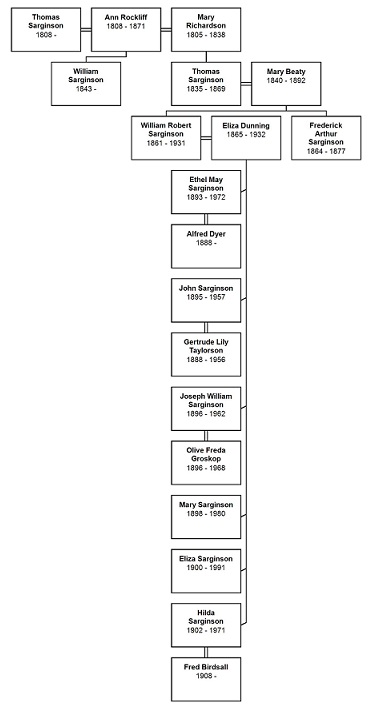
Descendant Chart for Thomas Sarginson

By 1851 the family had moved to Newcastle upon Tyne in Northumberland when Thomas senior gave his occupation as a chemist. They had moved back to Westmorland by the 1861 census and by that time Thomas junior had met and married Mary Beaty. The household census entry reads as follows:

AddressNameRelation to Head of FamilyConditionAge MAge FRank, Profession or OccupationWhere born
ColbyThomas SarginsonHeadMarried52 Veterinary practitionerNewbiggin Cumberland
 Ann SarginsonWifeMarried 53 Penrith Cumberland
 William SarginsonSonUnmarried 18ScholarAppleby Westmorland
 Thomas SarginsonLodgerMarried25 Student Royal Veterinary College EdinburghAppleby Westmorland
 Mary SarginsonWifeMarried 24 Scotland
1861 Census for Thomas and family

Interestingly, Thomas the younger’s entry listed him as a lodger, not a son, and it was annotated with the words “practising as a veterinary surgeon”. Thomas and Mary went on to have two sons:

  • William Robert Sarginson (1861-1931) – his birth was registered in Longtown but he did not consistently use this information on later census records.
  • Frederick Arthur Sarginson (1864-1877) – his birth was registered in Longtown and his death on 26 September 1877 in Barrow in Furness, Lancashire.  His mother Mary registered his death and their address was given as 29 Napier Street, Barrow.

Thomas committed suicide, at the age of 34, on 11 October 1869 in Longtown, Cumberland. He had obtained prussic acid from a local surgeon, Dr Francis Graham, citing his need for it professionally as a veterinary surgeon (Carlisle Patriot, 15 October 1869, page 4). An inquest was held into his death presided over by the coroner, Mr Carrick, and a jury was appointed (Cumberland and Westmorland Advertiser and Literary Chronicle, 19 October 1869, page 4).

Although he was said to have a good business, initially practicing in Westmorland and then Penrith, he was reported to have taken to drinking and been unkind to his wife Mary. In her evidence to the inquest Mary said that they had been married for nine years and had two children. She had left him four years ago and retuned to Longtown to live with her father. Three months ago, Thomas had persuaded Mary to return to him but a week before his death had left saying that he was going to collect money but he didn’t return. She had been left without money for food and all the furniture in the house, except the children’s bed, had been removed by her husband’s aunt and uncle. The only food they had had been provided by the neighbours. Mary had written to Thomas advising him of their plight but he hadn’t come home so she retuned to her father Robert Beaty’s house in Longtown (Cumberland and Westmorland Advertiser and Literary Chronicle, 19 October 1869, page 4). Robert was the gateman at Longtown railway station. Mary described her husband as:

Deceased looked very wild when he got drink, and was very passionate. He was much reduced in circumstances. She had always done her duty as a wife to him, the quarrels taking place through his drinking.” (Cumberland and Westmorland Advertiser and Literary Chronicle, 19 October 1869, page 4).

When Thomas returned to the home he shared with Mary and his children on 11 October he found that it was deserted; he then made his way to Longtown where he bought the prussic acid, half an ounce in a small phial. Dr Graham described Thomas as being sober and cleanly dressed (Cumberland and Westmorland Advertiser and Literary Chronicle, 19 October 1869, page 4).

After buying the acid Thomas went to his father-in-law’s house to see his wife. He was refused access, took the acid and fell down. What happened next was described as follows:

He was carried at once to the waiting room of the station and medical assistance brought, but it was of no avail, he died about an hour later, apparently without pain.”  (Carlisle Patriot, 15 October 1869, page 4)

The jury found that the “deceased had committed suicide by poison while insane”.
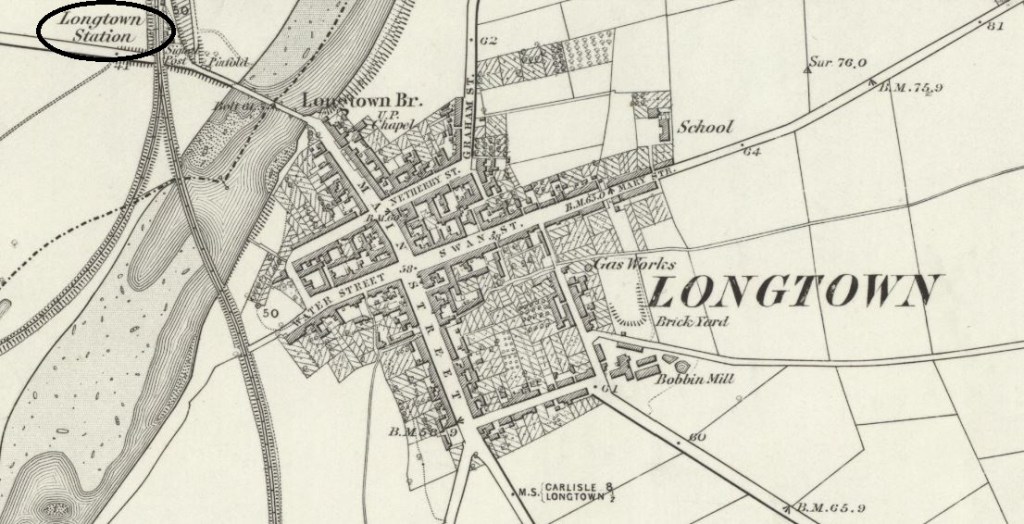
OS Cumberland X 1868 – extract showing Longtown and the railway station

 There is a postscript to this story as regards Dr Francis Graham. He was fined 5s at the Longtown Petty Sessions for “unlawfully selling a quantity of prussic acid without labelling the bottle with the word poison” (Christchurch Times, 30 October 1869, page 7).

After the death of Thomas, Mary continued to live in Longtown with her father and sons until at least the 1871 census:

AddressNameRelation to Head of FamilyConditionAge MAge FRank, Profession or OccupationWhere born
Longtown CottageRobert BattieHeadWidower56 GatekeeperLongtown, Cumberland
 Mary SargensonDaughterWidow 30DomesticLongtown, Cumberland
 William SargensonSon 9 ScholarLongtown, Cumberland
 Frederick SargensonSon 6 ScholarLongtown, Cumberland
1871 Census for Robert, Mary and her sons

The family left Longtown sometime before Robert Beaty’s death on 9 September 1892. His death certificate records that he died at 43 Napier Street, Hindpool, Barrow-in-Furness, Lancashire. Robert was described as a general labourer and his daughter Mary was the informant for his death. Mary was also the informant for her son Frederick’s death on 28 September 1877 when they were living at 29 Napier Street.

Thomas and Mary’s oldest son, William (1861-1931) was boarding with the Abbott family at 29 Napier Street, in the 1881 census. He was described as a fitter born in Appleby, Westmorland. The head of the household was Victor Abbott, a railway guard.

Mary continued to live in Barrow-in-Furness and in 1891 she was living in James Street with her occupation given as a monthly nurse. Mary died on 12 March 1892 at 18 James Street. Her son William was the informant when her death was registered. By then he was living at 16 Oxford Street, Stockton-on-Tees, County Durham.   William met and married Eliza Dunning (1865-1932) and together they had six children. In the 1911 census he was described as an engine fitter.

I am interested in knowing more about all the people mentioned in this blog post. Do contact me if you have any further information which you are willing to share.

Note: the map used in this blog has been reproduced with the permission of the National Library of Scotland under the following creative commons licence https://creativecommons.org/licenses/by-nc-sa/4.0/ and sourced from the NLS maps site https://maps.nls.uk/.

Bibliography

Appleby, Westmorland. https://www.genuki.org.uk/big/eng/WES/Appleby : accessed March 2021.

Baptisms, marriages and burials. https://www.findmypast.co.uk/ : accessed March 2021.

Barrow-in-Furness, Lancashire. https://www.genuki.org.uk/big/eng/LAN/BarrowinFurness : accessed March 2021.

Census records. https://www.ancestry.co.uk/ : accessed March 2021.

Longtown, Cumberland. https://www.genuki.org.uk/big/eng/CUL/Longtown : accessed March 2021.

Newspapers. Collection: British Newspaper Collection. https://www.findmypast.co.uk/ : accessed March 2021.

OS Maps. https://maps.nls.uk/ : March 2021.

William Sargison killed by lightning

Sometimes, when researching people, a specific record catches your eye. This was certainly the case with William Sargison (1786-1811), whose burial record from the parish of St Mary the Virgin, Cottingham, dated 14 June 1811, indicated that he was the son of Thomas (Sergeason/Sergesson) and gave his cause of death as “killed by lightening”. At the time of the incident Cottingham was located in the East Riding of Yorkshire, near to Hull, and its position has been marked on the following map (see bibliography for map attribution):

Map from Vision of Britain website

William is included in the “Sargison South Cave and beyond tree” which includes people living in Cottingham.

The story of William’s death seems to have been picked up by newspapers outside the local area. For example, a report in the Salisbury and Winchester Journal (24 June 1811, page 4) reported that:

During a thunderstorm at Cottingham, near Hull, on Wednesday afternoon, Mr Sarjeson, his son William, and his nephew, being all engaged in hoeing turnips, the former at the end of the field and the nephew and son at the other, the latter (son) was suddenly struck dead by the lightening, his face on one side was completely scorched, and his hat, clothes and shoes, all rent to pieces.

In other reports William’s age was given as 22 and that he was “a remarkably steady young man” (Stamford Mercury, 21 June 1811, page 3). None of the reports identify his father by his first name although they do report his surname in a number of different ways: Sargerrison and Sarjeson are just two examples.

William was buried in the churchyard of St Mary the Virgin, Cottingham, Yorkshire (see bibliography for photograph attribution):

St Mary the Virgin, Cottingham, Yorkshire

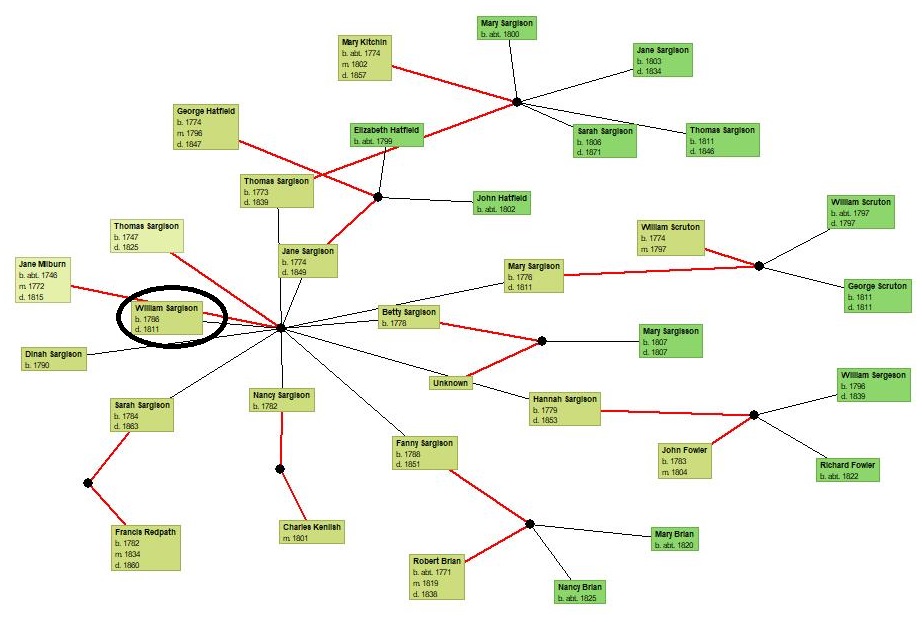
William was the youngest of two sons born to Thomas Sargison (1747-1825) and his wife Jane Milburn (1746-1815). His elder brother Thomas (1773-1839) continued to live in Cottingham with his wife and children. Thomas and William also had seven sisters, some of whom I’ve been able to trace. The following chart shows Thomas, Jane, and the children and grandchildren that I’ve found so far.

Descendant chart for Thomas and Jane

Bibliography

Baptisms, marriages and burials. https://www.findmypast.co.uk/ : accessed March 2021.

Cottingham. https://www.genuki.org.uk/big/eng/YKS/ERY/Cottingham : accessed March 2021.

GB Historical GIS / University of Portsmouth, History of Cottingham, in East Riding of Yorkshire and East Riding | Map and description, A Vision of Britain through Time. URL: http://www.visionofbritain.org.uk/place/979  Date accessed: 11th March 2021

Newspapers. Collection: British Newspaper Collection. https://www.findmypast.co.uk/ : accessed March 2021.

St Mary the Virgin, Cottingham. East Riding Archives, CCO, via Wikimedia Commons : accessed March 2021.

Ronald Ragsdale Sargison 1910 to 1987

Ronald (a member of the Sargison South Cave and beyond tree) was born on 10 November 1910 in Nottingham, England to parents Percy John Sargison (1876-1952) and Lucy Ann Ragsdale (1878-1951). At the time of the 1911 census Percy was described as a draper and outfitter and the family were living at 95 Sherwood Street, Nottingham. By 1939 Percy and Lucy had moved to 29 Ribblesdale Road and Percy was a credit draper and outfitter. In contrast their son Ronald was a Clerk in Holy Orders, single and living with Clarence and Elizabeth Beardall at Woodlands, Mansfield Woodhouse, Nottinghamshire.

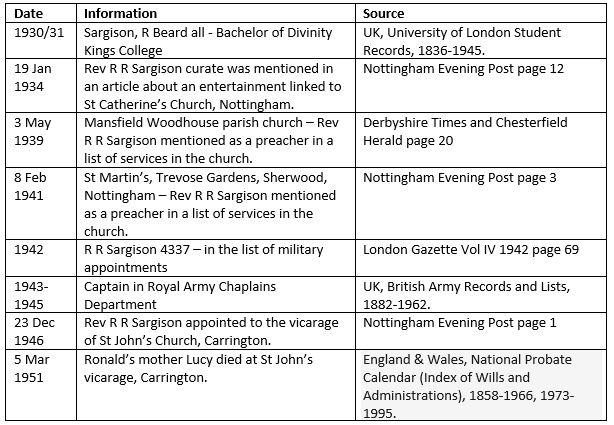
The following timeline for Ronald’s career has been constructed using a combination of primary sources (education, newspaper articles, passenger lists, probate records and electoral registers) and secondary sources. I was only able to access online resources which I subscribe to so have not been able to utilise clergy related occupational sources like Crockfords Clerical directory.

Table 1: Timeline for Ronald 1930-1951

Ronald married Olive Thompson (1910-1979), a widow, in Q4 1951, in Nottingham. Olive’s first husband, Frederick Thomas Thompson (1907-1951), had died on 28 June 1951. Olive had three children with her first husband, two of whom accompanied them when they went to Guyana in 1956. After their marriage the following table shows what happened next to Ronald’s career and his new family.

Table 2: Timeline for Ronald and Olive 1962-1964

The ship Ronald, Olive and family travelled to Guyana was called the Arakaka. It had been built in Teeside and was launched in 1946 as a cargo steamer. On its voyage in 1956 it carried 12 passengers and was operated by the Booker Line.

Secondary sources suggest that after his return to England, Ronald was the vicar of churches in Balham, and Hawthorn and Trimdon, both in County Durham. Ronald and his wife Olive moved at some point to Dulverton Hall in Scarborough, a home for retired clergy, which was replaced by a new property in 2002. Olive died in Q3 1979 and Ronald on 18 October 1987. Both their deaths were registered in Scarborough.  

I am interested in knowing more about all the people mentioned in this blog post. Do contact me if you have any further information which you are willing to share.

Bibliography

Carrington nr Basford. https://www.genuki.org.uk/big/eng/NTT/Basford : accessed January 2021.

Dulverton Hall, Scarborough. https://dioceseofyork.org.uk/news-events/news/dulverton-hall-one-of-the-cofe-pension-boards-best-kept-secrets : accessed January 2021.

England & Wales, National Probate Calendar (Index of Wills and Administrations), 1858-1966, 1973-1995. https://www.ancestry.co.uk/ : accessed January 2021.

FindmyPast British Newspaper Collection. https://www.findmypast.co.uk/ : accessed January 2021.

Goodrich, Revd Derek, H. (1994) A Short History of St George’s, Georgetown, Guyana. Georgetown: Revd Derek H. Goodrich.

Kneesall. https://www.genuki.org.uk/big/eng/NTT/Kneesall/ : accessed January 2021.

London, England, Electoral Registers, 1832-1965. https://www.ancestry.co.uk/ : accessed January 2021.

Passenger Lists Leaving UK, 1890-1960. https://www.findmypast.co.uk/ : accessed January 2021.

Ronald Ragsdale Sargison. https://enacademic.com/dic.nsf/enwiki/11014151 : accessed January 2021.

Tees Built Ships. http://www.teesbuiltships.co.uk/ : accessed January 2021.

UK, British Army Records and Lists, 1882-1962. https://www.ancestry.co.uk/ : accessed January 2021.

UK, Incoming Passenger Lists, 1878-1960. https://www.ancestry.co.uk/ : accessed January 2021.

UK, University of London Student Records, 1836-1945. https://www.ancestry.co.uk/ : January 2021.

West Yorkshire, England, Electoral Registers, 1840-1962. https://www.ancestry.co.uk/ : accessed January 2021.

Edward Sergesson’s (1803-1859) military career and two of his great granddaughters

Edward was born about 1803 in Stranraer, Wigtonshire, Scotland. He enlisted as a private in the 19rh Regiment of Foot in Leicester, Leicestershire, England on 7 December 1820. Edward was a cordwainer (shoemaker) by trade and aged 17. He was described as five feet five and a half inches tall with a fair complexion, brown hair and brown eyes. Edward had voluntarily enlisted for the bounty of three pounds to serve King George IV. At the time the regiment was commanded by Lieutenant General Sir Hilgrove Turner who is known as the officer who escorted the Rosetta Stone from Egypt to England. (He has an entry in the Oxford Dictionary of National Biography.) After Edward swore the Oath of Fidelity, he received the sum of two shillings and six pence.

During his military service Edward remained in the 19th Regiment of Foot. Unfortunately, his service record does not provide much detail about where he went with the regiment, although it is likely that he served in the West Indies and Ireland. Edward married his wife Mary Hennessey (1802-1864) in 1837, in Ireland, where his son Arthur was born about 1839. Their next child Mary Ann was born in 1843 in Jersey.

Edward was promoted to the rank of Corporal on 29 November 1836; a rank which he retained until the end of his service on 13 April 1843. He was aged 39 years and 4 months on his discharge and described as being five feet six inches tall with dark brown hair, brown eyes and a swarthy complexion with no marks or scars on his face or body.

After his discharge Edward returned to his trade as a cordwainer and settled in Glasgow, Lanarkshire, Scotland. With his wife Mary they had three more children: Edward James, John and (Thomas) Francis. Edward died on 3 March 1859 in Glasgow and Mary on 8 June 1864 in the Glasgow Poorhouse.

Edward and Mary’s son, Edward James Sergison (1845-1876), also became a soldier with the 2nd Battalion of 12th Regiment of Foot (later the Suffolk Regiment). He enlisted on 7 June 1859 and became a drummer. During his 13 years-service Edward spent just under two years in the East Indies. Sadly, he was admitted to the Sussex Lunatic Asylum on 3 February 1876 and died there on 19 March 1876.  His son Charles Sargison (1874-1937) enlisted in the Suffolk Regiment on 13 November 1889 aged 14 years and 8 months. He was discharged on 12 July 1892, probably as a result of suffering from ametropia, having served in Egypt and India.

Charles married Jane Elizabeth Deacon (b 1871) on 29 April 1897 in New Ross, Wexford, Ireland. Charles was from Stillorgan, county Dublin and a farmer. They had four children: one son and three daughters. By 1911 Charles was a grocer and farmer and the family were living in Stillorgan where they had a shop and a second-class house with between 2 and 4 rooms and 4 windows in the front.

Stillorgan commercial postcard dated around 1905 (Unknown source, Public Domain, via Wikimedia Commons

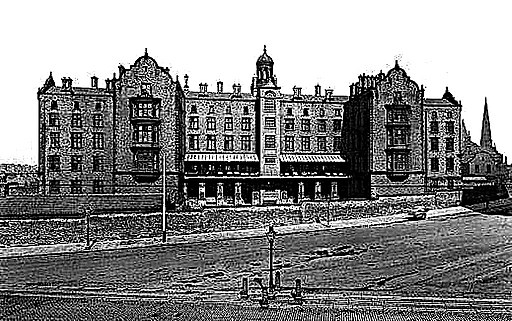
Two of Charles and Jane’s daughters became nurses. Both Isabella Florence Sargison (1898-1995) and Minnie Frances Sargison (1902-1954) trained in England and then returned to Ireland. Minnie was the first to undertake her training as nurse between 1923 and 1926. She trained at the Brownlow Hill Infirmary in Liverpool which was a large workhouse infirmary which was demolished in 1931.  By 1928 the Nursing Register shows that Minnie had returned to Ireland and was living in Grove View, Stillorgan.  

Brownlow Hill Infirmary, Liverpool (Unknown Author, Public Domain, via Wikimedia Commons)

Despite probably being a member of the British Red Cross Society Voluntary Aid Detachment in WWI, Isabella did not start her nursing training until 1924.  Her Nursing Register entry reports that her previous occupation was as a typist and that she was a cyclist. She trained at the Walton Institution in Liverpool and was registered as a Queen’s Nurse in 1927.

Both Isabella and Minnie added midwifery training to their qualifications, with Isabella completing her district training at the St Patrick’s home in Dublin between 15 April and 15 October 1829. The home was for mothers and babies and was run on strict lines. Both the Superintendent’s and Inspector’s reports indicated that Isabella was a good nurse but “lacking in enthusiasm and initiative”. However, it was noted that her “patients like her”.

By 1931 the Nursing Register shows that both Isabella and Minnie were living at Gove View, Stillorgan. They remained there until about 1937 when their address is given as 16 Sallymount Gardens, Ranelagh. They moved there with their father Charles as this was the address recorded for him on his 1937 death certificate; his daughter Minnie was the informant. Isabella and Minnie did not marry; Minnie died in 1954 and Isabella in 1995.

What I’ve found most useful in developing this story is the range of military records and the UK and Ireland Nursing Registers which can be found on-line. I am interested though in finding out more about the family. If you have information that you would be willing to share with me do please contact me.  

Bibliography:

Ireland. https://www.genuki.org.uk/big/irl @ accessed November 2020.

London Gazette. https://www.findmypast.co.uk/ : accessed November 2020.

Military records. https://www.ancestry.co.uk/ : accessed November 2020.

Military records. https://www.findmypast.co.uk/ : accessed November 2020.

Oxford Dictionary of National Biography. https://www.oxforddnb.com/ : accessed November 2020. UK and Ireland Nursing Registers. https://www.ancestry.co.uk/ : accessed November 2020.

Richard Sargeson 1789-1890

I recently received a query about a Richard Sargeson who died in 1890 and is buried in the MacMillan Pioneer Cemetery, Lancaster Township, Ontario, Canada. Details from the cemetery give his birth date as 24 May 1789, died 16 April 1890 and that he was a “native of Cumberland England”.  The question was: did he fit into any of my trees?  Well ever one to accept a request I set about trying to find him. I have two trees which feature Sargeson/Sarginsons and other variant surnames: Sarginsons in Cumberland and Westmorland and Serginsons of Cumberland and Derbyshire.

An initial search of both trees didn’t find a Richard Sargeson baptised in 1789, or thereabouts, in Cumberland. However, I did find a Richard Sargison baptised 30 March 1806 in Cumwhitton, Cumberland. His father George (1776-1862) was listed as a blacksmith in a number of records and at least two of George’s sons: George (1796-1885) and Isaac (1810-1893), were also blacksmiths. George is included in the Sarginson Cumberland and Westmorland tree. However, he did not marry his wife Ezat Wright (1771-1843) until 1797 although their first son George (1796-1885) was baptised before their marriage. It seems unlikely though that their son Richard is the one in question, although the Richard in Canada variously recorded his occupation on Canadian censuses as blacksmith and/or farmer.

I then set about collecting as much information as I could about Richard. His cemetery records said that he was aged 101 years, 11 months and 8 days when he died so I wondered if his death had been featured in a local newspaper. Unfortunately, I couldn’t find a digitised copy of The Glengarrian or Glengarry Times on the web, although it looks like the Ontario archives might have copies of these. I live in the UK so visiting the archive isn’t a practical proposition for me. Richard was also not consistent when he reported his age on a number of the documents, I found for him:

  • 1851 Canadian census his age was given as 58 suggesting a birth about 1793.
  • 1861 Canadian census his age was given as 71 suggesting a birth about 1790.
  • 1871 Canadian census his age was given as 77 suggesting a birth about 1794.
  • 1881 Canadian census his age was given as 858 suggesting a birth about 1796.
  • Memorial inscription his age was given as 101 years, 11 months and 8 days.

Using primarily census records I constructed the following family tree for him and it is interesting to note that the first names George and Isaac appear in his descendants and also that in some of the later generations the surname changes to Surgeson.

Horizontal Hourglass Chart for Richard Sargeson

So, if you are able to shed any light on this mystery do please contact me.

The unidentified John Sarginson

It was probably about a year ago when my brother Tim set me a family history challenge. He is interested in a specific name on the WW1 war memorial which resides in St Helen’s Churchyard in Escrick; the village we were born and brought up in. The man’s name was John Sarginson. Neither of my parents was able to shed any light on this man who shares the same surname as we do. Our uncle Taff, one of my father’s brothers, wasn’t able to help either when we asked him about him earlier this year. Mind you he didn’t know that one of his ancestors from a nearby village had served in World War One, survived and is included in one of the historical books about Riccall; the village which he lives in.

Anyway how hard can this be to identify someone who is currently unidentified I thought to myself. Well much harder than I’d anticipated is the short answer. I started with the Commonwealth War Graves Commission website and found some John Sarginson’s who had not survived the war but, having carried out further research,  I don’t think it is any of them. Then I thought well perhaps he is in some of the other WW1 records: Ancestry, Imperial War Museum lives of the Great War, Findmypast and the National Archives at Kew. No luck there though.

Then I realised that there would probably have been some meetings to discuss the war memorial and discovered that some papers and meeting minutes had been lodged at the Hull history centre as part of the Forbes Adam collection. Perhaps this was going to be the eureka moment that we family historians crave. Yes you’ve guessed it, it wasn’t. A very interesting letter from Lady Wenlock written in 1921, just after the commemoration service for the war memorial, did reveal some of the local feeling around it and some of the the names which had been included on it. But no the papers didn’t provide any information about who was going to be included on the memorial. A separate sub-committee run by the Rector made those decisions; and so far it doesn’t look these papers still exist or are accessible.

So it was back to the drawing board. After extensive further research, including also looking at the other soldiers on the war memorial and who they served with, I am no further forward in identifying the unidentified John Sarginson. I am loathe to leave him as a mystery so have written to the local historian who wrote a book about Escrick to see if he can help.

If you have any information about John then do please contact me. I have also posted this blog to my other genealogy website

Postscript: it looks like John may no longer be unidentified. He was probably Corporal John Sarginson of the West Yorkshire regiment. It would be good though to know more about his connection to Escrick as he wasn’t born there. If you have any further information do please get in touch.

Lottie’s afternoon tea

My Granny Sarginson (born Barrett in 1908) was called Lottie by her family and friends. It wasn’t until I was in my teens that I realised her name was Charlotte. I think it was on the day she looked at my hands and said that they were well kept and that you could tell I hadn’t done any real work. Hers were worn and cracked from years of looking after her ever growing family. My father was one of eight children.

There were a number of things I now realise that I learnt from my Gran. One of the most important of which was that meals should be eaten at the table. Every Sunday afternoon she would put on a tea for members of the family. Sandwiches of different kinds: ham, cheese and egg were the most popular. There would often be other savouries like sausage rolls and pork pies. A cake she had made herself usually took centre stage, together with jelly, tinned fruit and evaporated milk. I remain fond of tinned peaches to this day, especially now as it seems rather tricky to buy fresh peaches that aren’t hard or go rotten before you’ve had time to eat them!

Members of the family who didn’t live in the same village as my grandparents took it in turns to go to their house for afternoon tea. We were often there with my aunt, uncle and cousins from York. We would all sit up at the table to eat our food and drink our tea. If we were really lucky we would be offered fizzy pop: dandelion and burdock and cherryade were particular favourites. They were delivered to my Grandparents door in glass bottles with a refundable deposit

After we had eaten our tea we usually went to see which cousins were around to play with and spent time with them. That allowed Gran time to tidy up and for the grownups to have their own conversation without us children.

From time to time Gran would surprise us with something we hadn’t eaten before. The day we all shared a pineapple was particularly memorable. It took pride of place on the table when we arrived for afternoon tea. Both my father and grandfather were great gardeners; however this fruit wasn’t something they had experienced before. The pineapple was a major topic of conversation all the way through tea until eventually my Gran took it into the kitchen to cut it up. She removed the outer skin and sliced it or us to eat. What she didn’t do was remove the core and to this day I won’t eat that part of a pineapple even though I have been reassured many times that it is edible!

Sadly my Gran died in 1983 and looking back on her life now I can see that there are a number of things I learnt from her: the importance of sitting at the table to enjoy a meal, that there are many different ways to look at work and to be adventurous, particularly with food. She was a practical woman, born to a tenant farmer, her occupation described in the 1939 register as unpaid domestic duties and the mother of a large family with many Grandchildren and now Great Grandchildren; a legacy to be proud of.